
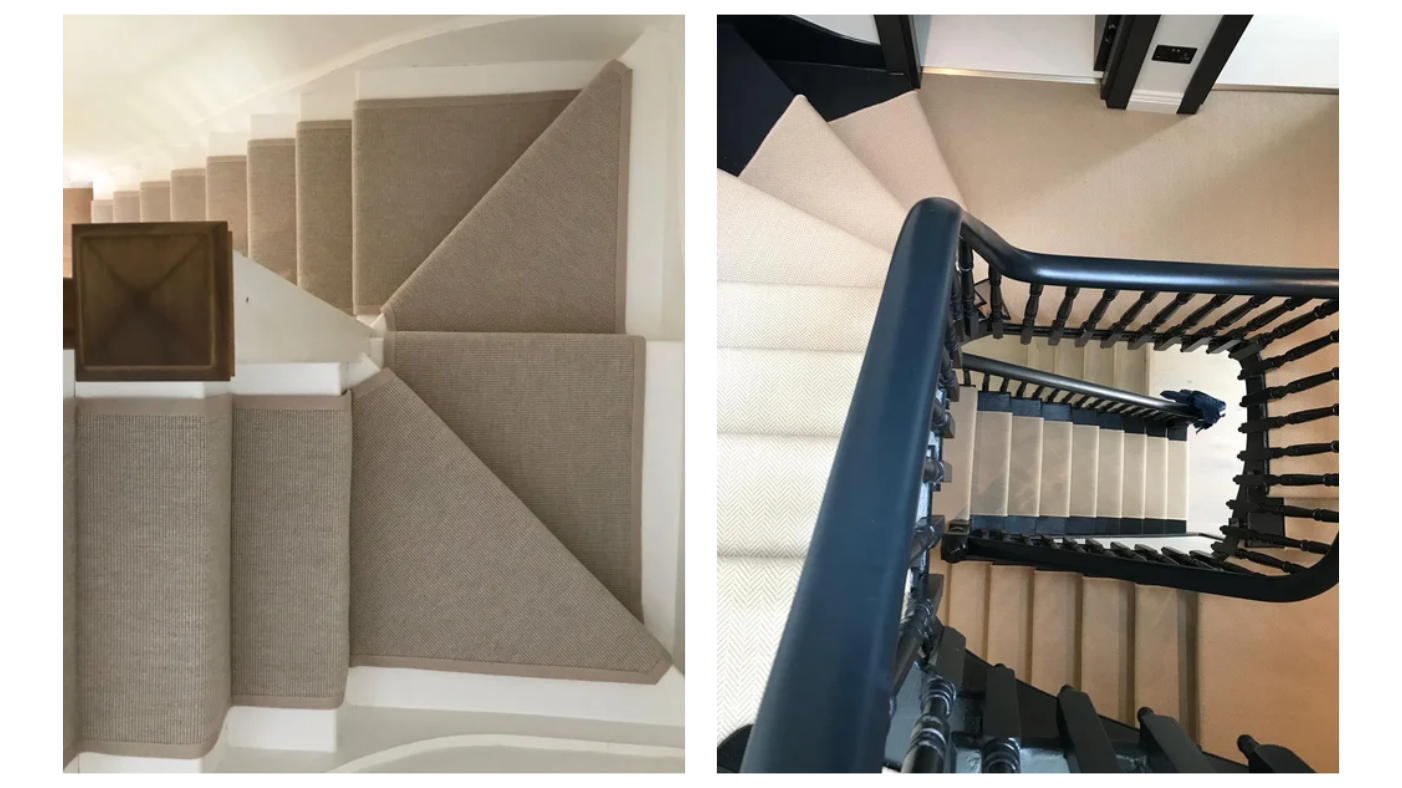
If your staircase curves, sweeps around a corner or has steps that change direction you might assume a stair runner is out of the question. Fortunately, that is not the case. A stair runner for curved stairs is possible, provided it is measured and fitted with care. The key is to make it to suit the shape of your staircase rather than expecting a shop-bought straight runner to work. Whether you have a sweeping staircase or a set of winders in a period North London home, there are ways to achieve a high-quality finish.
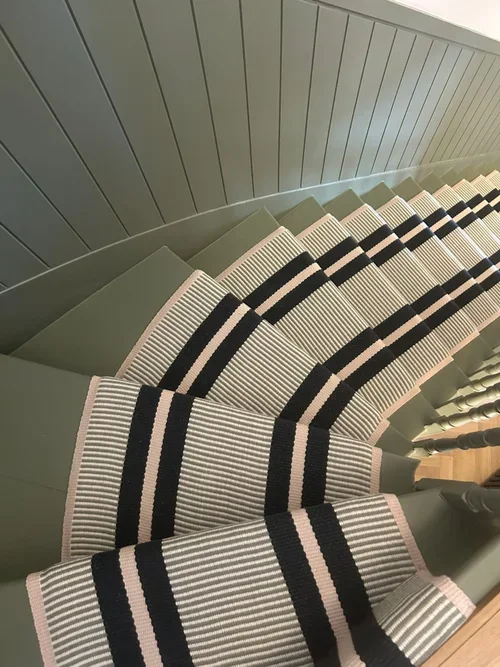
Why curved and winding stairs need a different approach
A straight staircase is relatively straightforward, as you might expect: the steps are generally uniform, and the runner follows a consistent line from top to bottom.
Curved and winding staircases are different. On a sweeping staircase, the treads change shape as the stairs follow the curve. On a staircase with winders (the steps that turn a corner) each tread is wider at one side than the other.
This matters because a straight-cut runner will not automatically sit neatly across these changing shapes. Without careful planning the edges can look uneven, the pattern may not follow the staircase properly and the overall finish can feel out of place.
The result should look like a natural part of the staircase, not an awkward addition to it.
Which stair runner styles work best on curves and turns?
The right material and pattern can make a considerable difference to the finished appearance of a curved or winding staircase.
Here are a few things worth considering.
Wool/Flatweave runners
Wool is a popular choice for stairs because of its natural resilience, comfort and ability to cope with everyday use. It is available in a wide range of colours and finishes, making it a versatile option for both traditional and contemporary homes.
If you are considering a wool runner, explore our range of wool stair runners to get a feel for the different possibilities.
Patterned runners
Stripes, borders and repeating patterns can look especially effective on a staircase. Patterns add definition and draw the eye upwards. However, they need careful consideration on curves and winders. A pattern that looks perfectly balanced on a straight staircase may behave differently when the runner changes direction. The positioning and alignment of the design are important to the overall result.
Sisal and faux sisal runners
Sisal has a natural, textured look that suits period and contemporary homes alike and faux sisal offers a similar appearance. If you like the natural look, explore our range of sisal and faux sisal stair runners and talk to us about which suits your staircase.
Ultimately, the best choice depends on the shape of your stairs, the construction of the runner and the look you are hoping to achieve. It is worth discussing your preferred materials and patterns during a home visit rather than choosing on appearance alone.
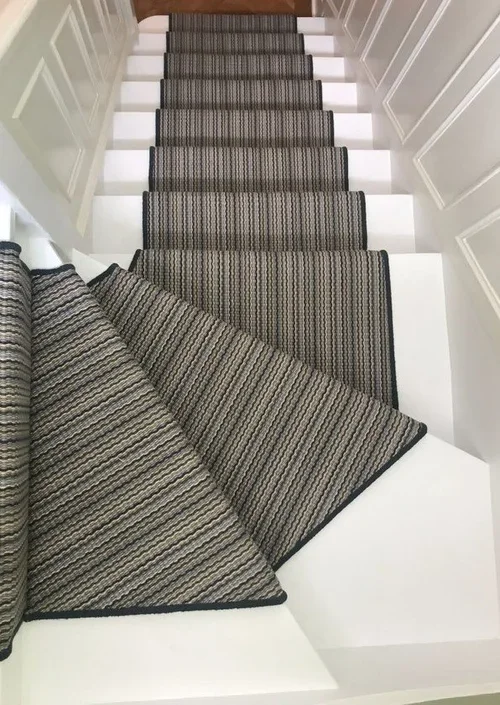
What happens when we survey curved or winding stairs?
With a curved stair runner, getting the measurements right is important. A staircase plan or a measurement taken from the straight section alone will not tell the whole story.
At B&R Carpet Company, the starting point is a visit to your home. We can look at the staircase in person, discuss the finish you would like and establish what will work with its particular shape. This is also an opportunity to look at samples in your own surroundings. A colour or pattern can look quite different against your flooring, paintwork and natural light.
For a curved or winding staircase, the first phase of the two part installation process is particularly key as this is when our fitting team will make a template of the winding steps so that they flow with the rest of your runner. We always aim for clean consistent lines but if you have something different in mind be sure to discuss it with us.
To start your stair runner project, tell us a little about your staircase.
The main curved and winding stair runner takeaway:
1. The shape and width of each step
The runner needs to accommodate these differences while maintaining a balanced appearance. We will assess the staircase and take precise measurements that take the flow and angles into account.
2. The position and width of the runner
The width of the runner affects the overall look of the staircase. Too narrow, and it can look lost against the steps; too wide, and it may overwhelm the exposed stair edges.
3. The carpet construction
Not every type of carpet will behave in the same way when used on a staircase with curves or turns. We offer a variety of options, including wool, flatweaves, sisal, faux sisal and patterned designs. It is worth discussing your preferred style with the team before making a decision.
4. Pattern direction and alignment
Stripes, herringbones and repeating patterns can look beautiful on stairs, but curves and winders introduce additional considerations.
5. The edging and finish
The edging is an important part of the overall design, particularly where the sides of the runner are exposed. We offer several finishing options, including tapes, double binding and whipping.
6. The surrounding staircase and interior
Think about what will be visible alongside the runner. Painted stair risers, natural timber, bannisters and existing flooring all contribute to the finished look.
7. The survey and fitting
Our service covers the process from initial selection and sampling through to expert installation and aftercare. For a staircase with curves or winders it is especially important to plan the details before installation.
Let's take a look at your staircase
A curved or winding staircase can transform a space. With the right choice of material, careful planning and an experienced fitting team it can become one of the most attractive features in your home.
At B&R Carpet Company, we are happy to discuss the possibilities and help you find an approach that suits your staircase and your interior.
Get in touch so we can see your stairs, talk through your ideas and advise on the options.
-
Yes. A stair runner can be fitted to a curved staircase, provided it is properly planned and made to suit the shape of the steps. The runner needs to follow the changing dimensions of the staircase rather than being treated as a standard straight installation.
-
They need a runner and fitting approach that accounts for the changing width and angles of the treads. The right solution depends on the staircase and the construction of the chosen material. An experienced fitter can advise on how to achieve a professional finish around the turns.
-
We take care of the entire process, from coordinating the delivery of your materials to carrying out the full installation. Managing everything in-house helps minimise disruption and ensures your project stays on schedule.
-
Yes. Head to our stair runner gallery or Instagram to find inspiration and ideas from some of our completed projects.
